The NY Times has a pretty good article on the reason for reason. It's not entirely wrong as there's a lot of cognitive biases and people tend towards defending their own ideas and attacking other people's ideas than about testing their ideas and rejecting them when they are wrong. Reason, used in this sense, is a tool or rather a cudgel for beating people with who disagree with what you believe, rather than taking any time to stop and consider and try to suss out what the truth is, rather than make your Truth win out over others Truths.
The understandings here should convince one that there's a deep and serious need for epistemology. That understanding how we should properly determine what is true and what isn't true is singularly important if you care whether your beliefs are true. If you care only about winning, then your beliefs are irrelevant. You can preach the gospel or fear the coming rapture. You can call Obama a socialist or claim that we should be socialist. The arguments and beliefs are largely pointless and unneeded. What matters is the truth, and to know the truth we need to know how we know we know.
I think that science is the only usable metric in this regard. That without testing our ideas against nature, we can't know anything about nature. The empiricism is a virtue. That if you accept evidence over your own current beliefs. You must have a low evidential inertia. You must find the evidence to be the ultimate arbiter, and everything wrong to be cast out. When Einstein did the calculations on what his theory said about the perihelion of Mercury, he about fainted, because it was right. It was observational evidence. But, if he were wrong, he would have rightly chucked it out the window, just as Kepler had to do with his rather beautiful analogy of the rotation of the planets as being within the perfect geometric shapes. It doesn't matter how beautiful your theory, if it doesn't fit the evidence it's wrong.
Therein is the real difference. That's the core of the issue. Without confronting the idea of epistemology you just get talking heads yelling at each other and argument is going to be nothing more than an attempt to win, and have very little to do with producing the correct result.
Showing posts with label Debate. Show all posts
Showing posts with label Debate. Show all posts
Thursday, June 16, 2011

Thursday, April 14, 2011
Truth as a wedge issue.
I was in Riverside earlier today listening to Richard Carrier speak, and one of the questions was concerning whether theists cared about the truth because some argued they did and others argued they don't really. And Dr. Carrier made the point that that is what makes it a fantastic wedge issue. It wasn't elaborated on, but certainly it's accurate, and has always been the rather core issue with religion.
If you care whether your beliefs are true, then there are a set set of things you should do. You should find a way to determine if something is true or false. You should find methods and a methodology by which you can determine what is true and what is false. And when you care about truth, your beliefs must always live and die by the evidence. Following closely from the desire to believe what is true is the requirement that we rely on evidence and reasonable argument. And that's a rather stunning trap. Because if one limits themselves to reasonable arguments and evidenced facts, you've cut off all paths that could get you to theism.
The want for truth isn't very hard to illicit from believers, so they really do care whether their beliefs are true or not. But, if you dig a bit with regard to their religious beliefs, this nice metric developed ad hoc suddenly becomes a heresy when you ask it to be applied to religion. On one hand theists want to accept what is true and not accept what is false, but on the other they don't care about the evidence at all or anything you say because they want to believe. And if they do that, they are accepting something less likely to be true over something more likely to be true, while they are allowed to do that, it's a rather serious problem. And if they are stuck there confronting their own cognitive dissonance it's not too much harder to ask them to admit that your position (not accepting any gods) is a perfectly valid one to hold because, after all it's more reasonable than theirs. They can try to weasel out at any point but they are damned if they do and damned if they don't. If they abandon the epistemological metric developed then they don't care whether what they beliefs are true or not. If they insist that there evidence matters, then the lack of evidence for theism in general or Christianity in particular is a serious problem, and the absence of evidence makes reasonable an absence of belief.
Treating "caring about truth" as a wedge issue forces theists to either abandon faith as an argument, or accepting that accepting faith as an argument means abandoning truth as a desire. They accept God as true on faith, and admit using faith as grounds means they don't care about believing true things. Or they can accept reasonable evidence alone which means they need should have a reason to believe resting on sound evidence and argument.
Finally, what does it say about the state of intellectual discourse in religion if "caring whether you believe true things" is a plausible wedge issue?
If you care whether your beliefs are true, then there are a set set of things you should do. You should find a way to determine if something is true or false. You should find methods and a methodology by which you can determine what is true and what is false. And when you care about truth, your beliefs must always live and die by the evidence. Following closely from the desire to believe what is true is the requirement that we rely on evidence and reasonable argument. And that's a rather stunning trap. Because if one limits themselves to reasonable arguments and evidenced facts, you've cut off all paths that could get you to theism.
The want for truth isn't very hard to illicit from believers, so they really do care whether their beliefs are true or not. But, if you dig a bit with regard to their religious beliefs, this nice metric developed ad hoc suddenly becomes a heresy when you ask it to be applied to religion. On one hand theists want to accept what is true and not accept what is false, but on the other they don't care about the evidence at all or anything you say because they want to believe. And if they do that, they are accepting something less likely to be true over something more likely to be true, while they are allowed to do that, it's a rather serious problem. And if they are stuck there confronting their own cognitive dissonance it's not too much harder to ask them to admit that your position (not accepting any gods) is a perfectly valid one to hold because, after all it's more reasonable than theirs. They can try to weasel out at any point but they are damned if they do and damned if they don't. If they abandon the epistemological metric developed then they don't care whether what they beliefs are true or not. If they insist that there evidence matters, then the lack of evidence for theism in general or Christianity in particular is a serious problem, and the absence of evidence makes reasonable an absence of belief.
Treating "caring about truth" as a wedge issue forces theists to either abandon faith as an argument, or accepting that accepting faith as an argument means abandoning truth as a desire. They accept God as true on faith, and admit using faith as grounds means they don't care about believing true things. Or they can accept reasonable evidence alone which means they need should have a reason to believe resting on sound evidence and argument.
Finally, what does it say about the state of intellectual discourse in religion if "caring whether you believe true things" is a plausible wedge issue?
Friday, October 3, 2008
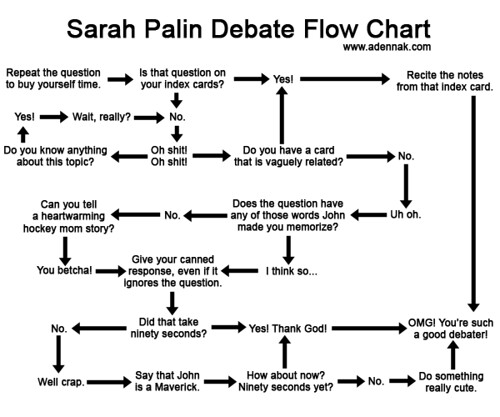
Vice Presidental Debate: Palin wins.
She answered every question. Her answers had no relation to the questions in question. Expecting otherwise would be expecting too much. And she didn't light the stage on fire. That's a win.
Friday, August 29, 2008
Wow. I'm the best debater ever.
Not really, but I'm apparently marginally good. I mentioned some of my Debate.com exploits and funbits here and there. Apparently they just updated the software to include a ranking system.
Hm. Ranking system.
Member Debates Won Lost Tied Win Ratio Percentile
Tatarize
92 69 19 4 75.00% 99.95%
Kleptin
83 50 25 8 60.24% 99.85%
solo
55 40 10 5 72.73% 99.79%
Logical-Master
75 39 31 5 52.00% 99.74%
DucoNihilum
55 37 13 5 67.27% 99.69%
I'm number 1!
Hm. Ranking system.
Member Debates Won Lost Tied Win Ratio Percentile
Tatarize
92 69 19 4 75.00% 99.95%
Kleptin
83 50 25 8 60.24% 99.85%
solo
55 40 10 5 72.73% 99.79%
Logical-Master
75 39 31 5 52.00% 99.74%
DucoNihilum
55 37 13 5 67.27% 99.69%
I'm number 1!
Monday, February 18, 2008
Debate: Hitchens Boteach
You'll never guess who wins.
Shorter version of the debate:
Boteach: The Jews are special and God gave us moral laws, but the Jews are not special and those moral laws are inherent within us. Hitches is depressing because evolution is depressing, which Stephen J. Gould didn't believe in, and you shouldn't either because its false and simply replacing God with time; but I believe it!
Hitchens: *POW*
Saturday, January 26, 2008
I'm too sexy for my brain.
So oddly enough another debate on Debate.com I managed to stump some creationist by posting a well documented easy explanation of evolution with a number of topical notes as to how exactly it all goes together. Explaining why there are marsupials Australia. He apparently tried for a bit and ended up posting several questions to me. You know, you see the same arguments being cut and pasted so many times you neglect to realize that there is a real person who really believes those arguments doing the cutting and pasting... and he's really stupid.
--"first were did the orginal orginism come from?"
--"how do you figure in the great flood?"
-- "how do you figure that this earth of ours just came about by chance with all the thins that had to be so perfect for us to live?"
--"why are we the most advanced species?"
-- "why dosnt all mothers have 14 arms? (because they would notice the need for another arm and that magic process would go into effect.)
He moved on to the topic of the Big Bang.
-- "if that tiny ball of matter was so hot wouldn't it purge it of all living organisms?"
--"if not why do we get sun burns?"
--"first were did the orginal orginism come from?"
I don't know. We have some generally good ideas as to some of the steps involved. There are easily generated organic molecules, fantastic catalysts, tiny easily produced replicative molecules, strong evidence that DNA even at very short lengths is fairly crystalline (crystals have a simple replication). Outside of these good suggestions we just don't know; I don't know.
--"how do you figure in the great flood?"
I don't. The great flood is a myth. There's no evidence geologically, biologically, historically, plausibly that it occurred. There was a time when geologists actually believed it, but a preponderance of the evidence made even the most ardent of finally admit that there should be some evidence and clearly was not. For example, we have societies which show continuous existence during the time of this supposed flood. The oldest living thing on the planet is a Creosote bush in the Mojave desert 11,700 (5,700 years older than the universe) years old. Further, we have uninterrupted tree ring records from all over the world going back about 11,000 years. Further, floods leave a very distinctive mark in the rocks. Just as we can tell that some globally bad thing happened by looking at rocks 64 million years ago from anywhere on the Earth, a local flood would leave a similar mark on our geology.
-- "how do you figure that this earth of ours just came about by chance with all the thins that had to be so perfect for us to live?"
If the Earth didn't exist in such a fashion to allow life to arise it would be impossible to be here and ask that question. There are 70,000,000,000,000,000,000,0000 stars in the universe. Probably a good number of planets around those stars. The fact that life arose on a planet which life could arise on is of very little mystery. Also, to say that the planet is perfect for us is a bit like saying my hand is perfect for a glove. We evolved on this planet and so we are well adapted to the changing conditions. Further, our species is unique in that we adapt not only to our environment but have adapted our environment to us. You'll find humans in the eastern part of the US living happily even though that part of the country is pretty frozen.
--"why are we the most advanced species?"
We aren't. Evolution doesn't work that way. It isn't a race to some advantageous goal it's a bootstrapping little edges to drive a population. There are far fewer organisms existing than could exist, if you look at the breeding patterns of any organisms from bacteria, to rabbits, to insects, to humans you find that within a short number of years it should be possible to coat the planet. However, there's a struggle for resources and different members of different species fight for their own advantages. Sometimes small genetic tweaks will cause an organism to be slightly better or worse in this struggle. The worse organisms are quickly driven extinct whereas the slightly better organisms will use this edge in their struggle to survive passing on this improved genetic characteristic to more offspring and becoming a major factor in the species. This doesn't say anything about a species being the most advanced or the best. Every species is as well adapted within their struggle to survive as humans are adapted within our struggle to survive. There's nothing inherently superior about humans over rabbits, over grass, or birds. We are just as adapted towards our survival as they are towards theirs. There isn't a goal in evolution so the suggestion that we are closer to that goal than lions is a rather misguided idea. Lions are adapted to their struggle and we are adapted to ours. Generally organisms occupy different niches so it's a lot like apples and oranges... apples are adapted to their niche and oranges to theirs.
-- "why dosnt all mothers have 14 arms? (because they would notice the need for another arm and that magic process would go into effect.)
Evolution is not a magical process. It's a gradual process. If you could gradually require the addition of an arm from a fairly pointless arm stub to a fully functional arm you could evolve one. However, our general body plan is the same as all vertebrates fish had two front fins and two hind fins so now all species originally evolved from fish have this same general plan and gradual modifications (a major change is nearly impossible to occur and be helpful to an organism). Slow gradual change, tweaks which give slight edges to organism in their struggle within their species.
He moved on to the topic of the Big Bang.
The scientific evidence does lead one to accept that the universe began 14 billion years ago from an original point. I highly recommend Richard Carrier's piece on why he was a Big Bang Skeptic and the scientific evidence behind it explaining why he accepts the theory now.
http://www.infidels.org/library/modern/richard_carrier/bigbangredux.html
-- "if that tiny ball of matter was so hot wouldn't it purge it of all living organisms?"
It's worse that that, it wouldn't have been able to become matter for a while. It would have been impossible to have any complex structures at all. However, the Big Bang does not contain living organisms. Those come far later. The universe is 14 billion years old. Our planet is 4.55 billion years old, our sun is a little older than that (few hundred million years or so). However life didn't come on to the scene until about 2 billion years ago. So as far as we can tell the entire universe was lifeless for 12 billion years. Complex life has only been around for about .6 billion, and we've been around for about .001 billion years (high estimate 100,000).
--"if not why do we get sun burns?"
Sun burns are actually burns. The UV rays of the sun actually damage the our skin. Life in the struggle for survival has developed slow gradual tweaks which allow for protection from the sun to reduce the damage to our skins from over-exposure to sun light. However, where light is less abundant (such as northern Europe), lighter skin evolved as a little tweak to increase the production of Vitamin D. Vitamin D is an extremely useful molecule for our development and is produced when UV light hits our skin. So the previous adaptations of increased melanin to protect the skin from the light were not as advantageous in northern environments. So when the gene used for melanin transport in the skin would break (as tends to happen here and there) it became one of those edges in struggle for survival in the northern environment allowing people to produce more Vitamin D. Because of the reduced sun effects the necessity of protection from sun burn was lessened. However, when you move people adapted for dimmer climates (adapted towards Vitamin D production rather than UV protection) into more sun rich climates they aren't as well as adapted as their darker skins cousins resulting in sun burns.
It's similar to Kettlewell's peppered moths experiments where the lighter colored moths were better adapted to one environment (lighter color trees) and darker colored moths were better adapted to another (darker color trees). Slight adaptations to slightly different environments. If you put the lighter color moth on a darker color tree it has a noticeable disadvantage. In the moth's case it's increased predation by great tits in the case of humans it's sunburns.
Sunday, January 20, 2008
God does not play dice with the world...
The old Einstein quote, "God does not play dice with the world." -- He was apparently wrong. It looks like the world is composed entirely of little dice.*
No, there isn't a point to this post, I simply wrote that as a comment at debate.com and thought it was hella clever.
No, there isn't a point to this post, I simply wrote that as a comment at debate.com and thought it was hella clever.
Saturday, December 29, 2007
Lacking content, must steal interesting content from Scientia Natura
Ah, content...

Christmas went well. No complaints. Didn't get a watch. Must now kill family, buy watch, or fix the watch I have. Got stuff I wanted and didn't know I wanted. Playing around some more on Debate.com getting less shiny.
Argued a couple times on "In God We Trust" being unconstitutional. Lost once, won twice.
I think I could have won a debate that the Bible was infallible (not not infallible). But, all the typical Christian voters were probably pushed away when I made a comment about how stupid anybody would be for believing any lick of this argument. *sigh*. I won a few arguments against a crazy person.
Fun. Still alive. Cold (for some reason Southern Cali is chilly / I know the rest of the States are frozen but nippy isn't typical).
Christmas went well. No complaints. Didn't get a watch. Must now kill family, buy watch, or fix the watch I have. Got stuff I wanted and didn't know I wanted. Playing around some more on Debate.com getting less shiny.
Argued a couple times on "In God We Trust" being unconstitutional. Lost once, won twice.
I think I could have won a debate that the Bible was infallible (not not infallible). But, all the typical Christian voters were probably pushed away when I made a comment about how stupid anybody would be for believing any lick of this argument. *sigh*. I won a few arguments against a crazy person.
Fun. Still alive. Cold (for some reason Southern Cali is chilly / I know the rest of the States are frozen but nippy isn't typical).
Friday, December 14, 2007
Still more fun with debate.
I can't argue with entertaining. So the votes on my Queen debate oddly have me doing pretty good. Whereas the the argument on Once Saved Always Saved is that much worse. I'm actually close to lose. It's pathetic, he didn't even have an argument. *sigh*
Still. It's a bit like that.
My latest is on Iraq. Apparently I'm a flaming liberal!
To which I responded:
Which I daresay is pretty good... which could mean anything.
Still. It's a bit like that.
My latest is on Iraq. Apparently I'm a flaming liberal!
Considering the interests of the Iraqi people, the U.S. and Allied troops, and the honor and integrity of this great nation, we must stay in Iraq until the job is done.
We may never know if Saddam Hussein actually had W.M.D.'s in Iraq. Reports do show that he had acquired W.M.D.'s and may have filtered them through other countries over the past 20 years. Regardless, Saddam and his government were responsible for the murders of thousands of innocent Iraqi citizens. There were ordered executions of political opponents and advocates of free speech.
I firmly believe that if we pull out of Iraq right now we will lose the integrity and honor that American servicemen and women are fighting for this very hour. We cannot leave the Iraqi's with false hopes. We must defeat the enemy on their ground or we will have to fight that war on our turf, amongst our neighborhoods, and with our children watching it with their own eyes.
To which I responded:
What job? Which job are we doing? Fighting both sides of a civil war? Establishing democracy in a region barely governable by tyrants? Stealing the oil? Getting rid of the WMDs? Attacking them there so they won't swim the Atlantic and attack us here? To replace a dictator who opposed the terrorist with terrorists and funding operations for terrorists?
Most of your arguments are sunk cost arguments. They are the flawed logic that leads people to wrongly refuse to cut their losses. The logic which makes people bet their bottom dollar on bad cards, or support a losing effort simply because we have lost by supporting it. The costs and losses, failures and successes, in the past, are irrelevant to the choice to stay. The question you should be asking yourself isn't how much we've lost for so little and what we can do to make it mean something. You should be asking yourself if, we know today what we know today... would you put the troops on the ground? If Iraq is as war-torn and messed up as today, do we put boots on the ground knowing what we know? There are no weapons of mass destruction, no Saddam, no greetings as liberators. Do you invade a gutted country with little hope for anything? I say the answer is no. Now, the sunk cost fallacy says that each time you weigh the decision, what you've "invested" is irrelevant. The millions of displaced and murdered Iraqis, the couple trillion dollars this war has cost, the thousands of American Soldiers lives, and the international loss of faith are irrelevant, not to mention the bogus reasons for waging the war. The question is, would you put boots on the ground today? If the answer is no, then we shouldn't have boots on the ground. Just as you shouldn't invest another billion dollars in a project which has produced nothing and doesn't show signs of producing something. Just as you shouldn't keep calling to the river with a hand you invested too much with on the flop. You don't throw good resources after bad.
You cut your losses with the situation you have today.
As you brought up some of these pointless notes allow me to address them:
* The only reports showing Saddam Hussein had some W.M.D.s were the once receipts of those weapons we gave them during the Iran-Iraq war. After that point the good intelligence suggested that he wasn't developing them, and it took a considerable amount of cherry picking to invent a story that he had them or was even developing them. We had weapons inspectors on the grounds before Iraq's infrastructure was destroyed. If we actually wanted to look for these phantom weapons that would have been the time to do it. We had the world community ready to pressure the hell of Iraq. We had that threat contained. If that was the intent, deciding to go to war anyway was beyond stupid.
We cannot justify staying in Iraq today because the president mislead the American people. What happened then is a treason, but has nothing to do with the question at hand. Is it worth it to stay, when we look at what we can gain or lose in the future? We know how much we are losing in this war, and we know what we won't lose if we leave.
* As for the question of "IF" he had weapons. The Duelfer couldn't have been any more clear, there were no weapons of mass destructions in Iraq. Just as Iran has, as we learned recently, shut down its program as well. The entire line of debate concerning the completely botched job selling the American people this war doesn't matter. Yes, it was horrible. Yes, it was wrong. No, it doesn't matter.
We cannot justify staying in Iraq today because the president mislead the American people. Presenting phantom "reports" which suggest he magicked away his reportedly massive stockpiles doesn't matter at all. To put this in perspective, imagine if Saddam had massive stockpiles, we found them and we removed them all during the war and we are now in a situation where Iraq is exactly like it is, and we managed to stop a massive threat. This would perhaps justify the invasion in 2003, but it would not justify a continued presence in 2007. Again, that's the sunk cost fallacy. What are we going to gain if we stay there? What are we going to lose?
* As for the claim that the war is justified because Saddam is a bad man, that is also a sunk cost. It doesn't matter. We aren't fighting Saddam anymore, we are watching as millions of Iraqis are murdered and displaced. While we try to secure a small area in order for the Iraqi government to sit around and do nothing.
Sure, Saddam was bad. There are a lot of bad men in the world. However, it doesn't justify staying. It cannot justify staying. If we were still fighting Saddam, that might have been a point to argue. Though, we could have done that with a sniper bullet rather than a full ground war. But we aren't still fighting Saddam.
* The claim that pulling out of Iraq will dishonor the integrity of the troops is laughable. They do what we ask of them, even if we just set them in the middle of a civil war and give them nothing to do. Just as bringing them home will be easily followed.
They have done nothing wrong. They have not been dishonored nor have had their integrity questioned. The Administration is dishonored. The Administration is without integrity. The reason the sunk cost fallacy is so powerful is because of pride. People hate to realize that they lost a lot and gained nothing (less than nothing in this case). Losing a lot more in order to pretend a chance exists that those losses are not in vain is dishonorable and shows an extreme lack of integrity. Declare victory and bring the troops home. They did everything we asked of them, and though those who asked were incompetent it should not, and would not, make the troops look bad.
* The majority of the "enemy" only exists on their turf. We are talking about people who have some stolen Iraqi weapons from depots we left unguarded with perhaps an old Iraqi soldier from Saddam's disbanded army. These aren't the kinds of people who can fly across the Atlantic very easily.
I will however grant you that, of all of your arguments, this is the one and only argument which isn't sunk cost. It is the only argument which doesn't say... we screwed up so bad we must stay. We screwed up so bad that we might as well stay. We screwed up so bad that we will look bad if we don't stay. We gained a small bit for the massive losses and those things justify our staying. We are actually discussing future downside here. We are looking at a consequence of leaving with regard to future events. This weak nothing of a pathetic argument is the only shred of anything which even remotely qualifies as a reason to stay. How sad is that? The only 'real' argument you have is that if we don't have easily available American troops to be murdered by cowardly roadside bombs some poor Iraqi is going to travel five thousand miles to stick out like a sore thumb and try to kill some American here. How about we spend one tiny fraction of what we spent on the Iraq war to make sure people can't do that rather than putting troops in harms way as fodder! If the Iraqis don't have some local Americans to kill they will have to come to our turf where they have no upper hand. That isn't an impressive argument. Moreso when one considers the facts that our boots on the ground in Iraq are breeding more terror. Terrorism numbers have been skyrocketing as a result of our actions. And in the future, looking at the numbers we will have more terror if we stay than if we go.
We will save 8 billion dollars a month, thousands upon thousands of American lives, and prevent terror by leaving. If we stay, we will lose billions, respect, lives, and continue to make Iraq a hotbed of terror.
We should cut our losses. Take our victories, declare victory, come home, throw a parade for the troops and focus our efforts on security. I don't care if doing so will dishonor the Administration for making really bad choices.
Which I daresay is pretty good... which could mean anything.
Thursday, December 13, 2007
Once Saved Always Saved / Queen
So checking out the About Agnosticism/Atheism forum (which I frequent) somebody noted that there's a site called debate.com. I registered up and decided to debate: My first debate was that if you are Once Saved Always Saved as an element of Christian doctrine. I argued point #2 of Five Point Calvinism, that you are elected by God to be saved. And thus you are not saved until your dead and saved. Thus, as salvation is forever and you can only get it once. I win. Well I should win, my debating skill was pretty clearly superior as were my arguments.
It was kind of funny. At the end he said I was an atheist and shouldn't be allowed to argue or something. Classic.
I then accepted a debate that Queen was not easily the most popular and influential band in the history of the post-Beatle era. I tried. But it's like arguing that 2+2=5. After I finished my arguments, I voted for the Pro side.
It was kind of funny. At the end he said I was an atheist and shouldn't be allowed to argue or something. Classic.
I then accepted a debate that Queen was not easily the most popular and influential band in the history of the post-Beatle era. I tried. But it's like arguing that 2+2=5. After I finished my arguments, I voted for the Pro side.
Thursday, November 29, 2007
Not literally true in every respect.
Giuliani: I believe it, but I do not believe it necessarily literally true in every respect. I think there are parts of the Bible that are interpretive. I think there are parts of the Bible that are allegorical. I think there are parts of the Bible that are, um, meant to be interpreted in a modern context. So, yes, I believe it. I think it's the greatest book ever written.
Ah, the biblical equivocation of metaphor.
Metaphors are figurative language and as such aren't considered true or false. Declaring the Bible to be metaphorical allows one to assert the truth of the book without defending it. Subsequently slipping back to the definition of true in the sense of reality after the calls to defend the Bible subside.
One gets to call the Bible true, without saying something crazy like the Bible is a crazy and nobody sane would believe that stuff. Or that sure you believe in Jesus but you don't believe in Adam and Eve, even though from the text it would appear Jesus believed in Adam and Eve and (according to original sin) Jesus died in order to clear the sin, because (according to Trinity) Jesus was unable to just forgive the grudge he was holding against all mankind without a little Sadomasochism. That's what we want in our first-century wish granting zombie Jews (who when properly telepathically give enough passion for issues will pull us into the sky and make us live in eternal bliss), we need one with bad problem solving skills! However, to say that the story of Adam and Eve is a metaphor just adds insult (some insults are true) to injury.
Jesus apparently, according to the story, is exactly like Christian martyrs*, in that, he died for a lie.
*not to suggest that there were many of these.
Sunday, October 28, 2007
Hitchens v. McGrath
Hitchens v. McGrath
Hitchens: Either the Bible is true or it isn't, and it seems bloody obvious that it isn't.
McGrath: I want to say that there are respectable opinions and you've said something very interesting. We can't simply dismiss different...
McGrath has the lowest signal to noise ratio of any theologian.
Hitchens: Either the Bible is true or it isn't, and it seems bloody obvious that it isn't.
McGrath: I want to say that there are respectable opinions and you've said something very interesting. We can't simply dismiss different...
McGrath has the lowest signal to noise ratio of any theologian.
Saturday, October 6, 2007
Wednesday, October 3, 2007
Lennox/Dawkins Debate.
So PZ had the good sense to clue us infidels into a debate over the God Delusion, via a large number of Christian radio stations.
The format was intended to go as follows:
1) Some read from Dawkins' book.
2) Dawkins says that he wrote that.
3) Lennox pitches a McGrathian fit.
4) Goto 1.
This was admittedly "frustrating" to Dawkins who promptly started to ignore the stupid rules and rebut Lennox on his next chance to talk. The debate then had Lennox getting crushed pretty hard, mostly because Dawkins didn't need to think of new replies as everything Lennox said was stupid and long since disproven (and long since worked out with the best replies).
As I don't have a copy of the Audio some of PZs commenters pointed out the debate comments on the shows site. PZ also made the pointed out the structural problems. To the credit of Dr. Don McDonald, on the show comments he noticed it too. Dawkins should have been defense and going second rather than the pathetic situation of making the argument at the end.
The comments are rather classic:
1. Didn't read the book. He says that.
2. Didn't read the book. He gives a good explanation for morality as he did in the debate.
3. And?
4. Complete misrepresentation.
Or as Jason Bradfield notes,
Jason doesn't seem to understand a lot of what was said, but he's sure the Dawkins got kicked.
The format was intended to go as follows:
1) Some read from Dawkins' book.
2) Dawkins says that he wrote that.
3) Lennox pitches a McGrathian fit.
4) Goto 1.
This was admittedly "frustrating" to Dawkins who promptly started to ignore the stupid rules and rebut Lennox on his next chance to talk. The debate then had Lennox getting crushed pretty hard, mostly because Dawkins didn't need to think of new replies as everything Lennox said was stupid and long since disproven (and long since worked out with the best replies).
As I don't have a copy of the Audio some of PZs commenters pointed out the debate comments on the shows site. PZ also made the pointed out the structural problems. To the credit of Dr. Don McDonald, on the show comments he noticed it too. Dawkins should have been defense and going second rather than the pathetic situation of making the argument at the end.
The comments are rather classic:
"Dawkins conceded much more in the debate than I expected. 1. That God cannot be disproved. 2. He had no explanation for morality. 3. That we don't know the origins of the universe. 4. That the staggeringly evident hypothesis would be creation.
1. Didn't read the book. He says that.
2. Didn't read the book. He gives a good explanation for morality as he did in the debate.
3. And?
4. Complete misrepresentation.
Or as Jason Bradfield notes,
"Dawkins got owned. He got completely ripped on the morality issue and historical issues. He also got ripped on the celestial teapot stuff, which is a category mistake. Dawkins can't deal with God as He is explicitly revealed in Scripture. He has to create his own "created" idol."
Jason doesn't seem to understand a lot of what was said, but he's sure the Dawkins got kicked.
Subscribe to:
Posts (Atom)